Deciding at the kitchen table before the first quilting line

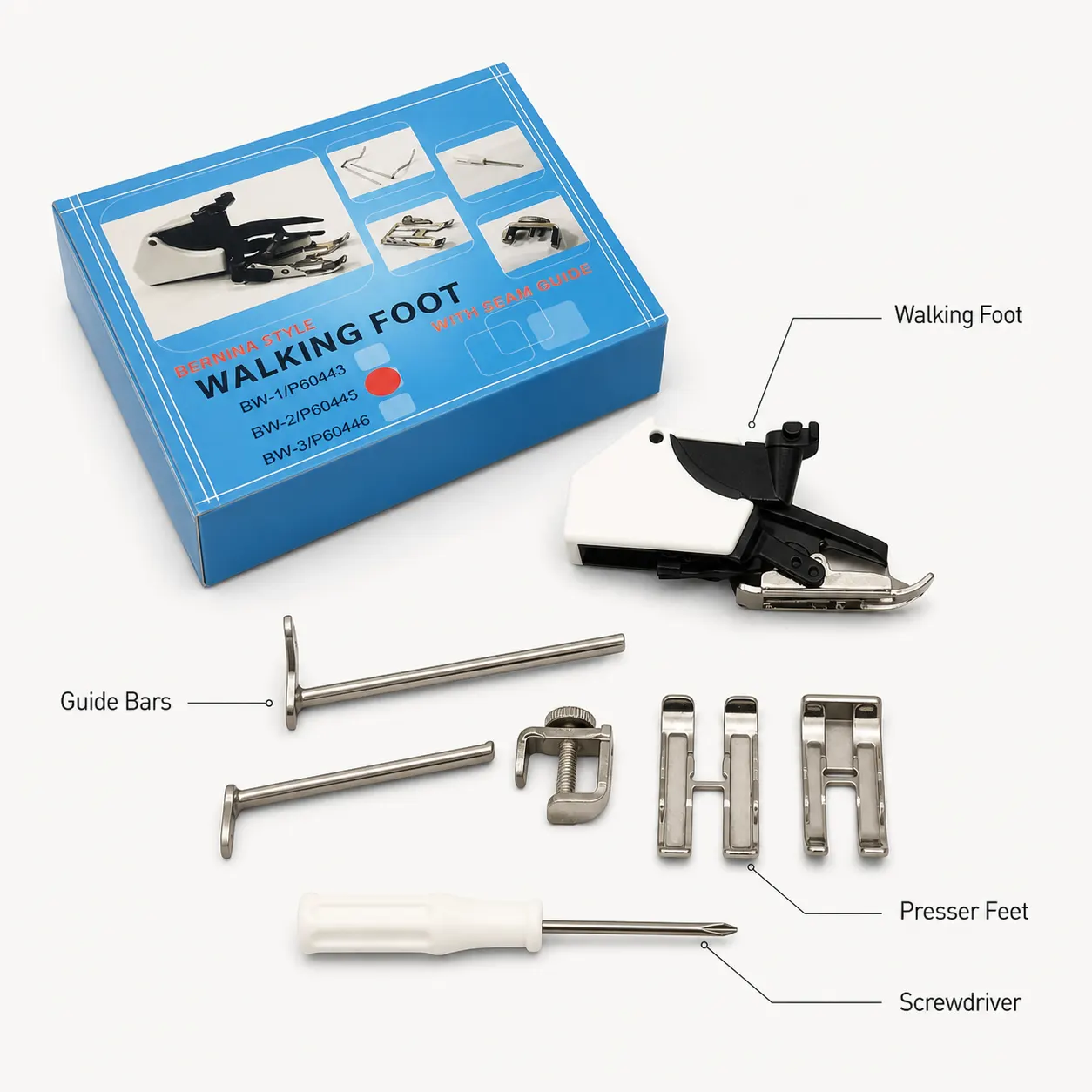
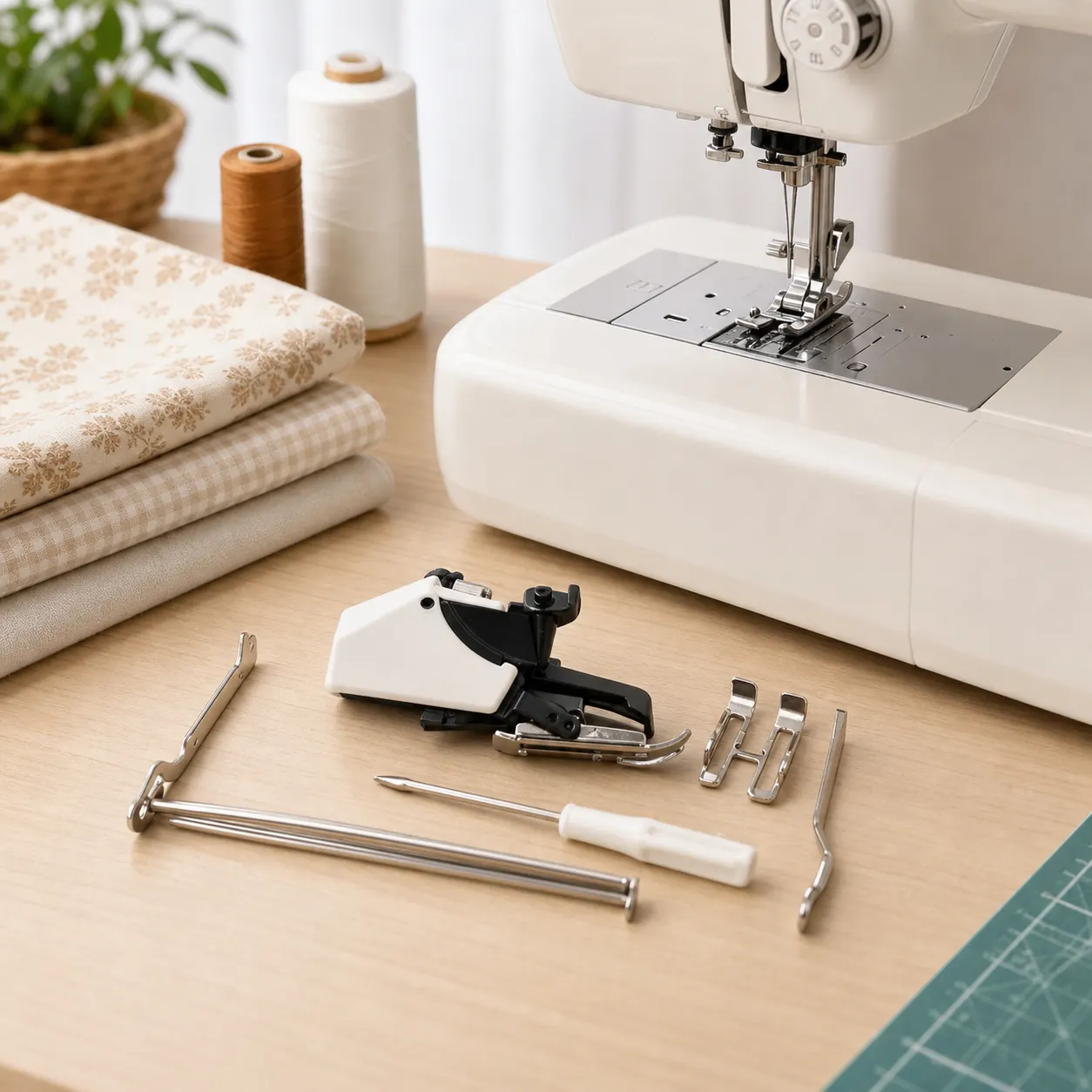
If you are searching for a walking foot for quilting UK, the practical answer is this: consider one when you want to sew straight or gently guided lines through layered fabric on a household sewing machine, but do not buy until you have checked compatibility against your own machine. The documented product here is a P60445 synchronous-feed presser-foot accessory set for household sewing machines. That tells you the category and intended machine setting, but it does not prove fit for every brand, shank type, stitch width, needle position or quilting method.
Picture the job at a kitchen table in Leeds, with a baby quilt basted, rolled and waiting beside a domestic machine. The decision is not whether quilting is possible without another accessory. Some small projects can be managed with careful basting, a standard presser foot and slow sewing. The decision is whether the next stage is likely to punish uneven feeding. If the top layer creeps ahead, the backing wrinkles underneath, or binding shifts as you sew, a synchronous-feed style presser foot is worth investigating before the real quilt goes under the needle.
Matching the quilting job to a household sewing-machine accessory
A walking foot is usually discussed by quilters because quilt layers behave differently from a single garment seam. A quilt sandwich has a pieced or plain top, wadding and backing, all moving under pressure. On a domestic machine, the feed dogs move fabric from below, while a regular presser foot holds from above. A synchronous-feed presser foot is meant to help feed from the top as well, which is why buyers look for it when straight-line quilting, binding or sewing layered home projects.
The documented facts for this item are deliberately narrow. The offer names a P60445 synchronous-feed presser-foot accessory set, lists the accessory name as a presser foot, and states household sewing-machine application. That is useful, but it is not enough to treat it as a universal quilting solution. For a quilter in a Bristol sewing class, those words place the item in the right broad family. They do not replace checking the machine manual, the fixing point, the shank arrangement, the needle clearance or whether your intended quilting line needs a different type of foot.
Checking the documented facts before you rely on the foot
Start with the facts that are actually documented. The product title identifies a P60445 synchronous-feed presser-foot accessory set for household sewing machines. The listed attributes identify it as a presser foot and as a new sewing-equipment accessory. The public copy is limited, so treat the listing as a starting point rather than a complete fit guide. There are no documented measurements, no documented brand list, no documented stitch-width range, no documented included guide bar, and no documented material-specific promise.
That matters because quilting mistakes are often caused by assumptions made before sewing starts. A buyer may see the words walking foot and imagine it will fit a Brother, Janome, Singer, Bernina, Pfaff or older machine without checking. The safer reading is narrower: it is a household sewing-machine presser-foot accessory, and your machine must still accept it physically. If your current problem is puckering on a patchwork throw, the fit check comes before the quilting plan. A foot that looks right online but cannot attach cleanly is no help at the needle plate.
Spotting mismatches before the quilt is under the needle
Do not buy this kind of accessory if your real need is free-motion quilting with fabric moved freely in curves, loops or dense patterns. A walking foot is associated with controlled feeding, especially straight-line work, not dropping the feed dogs and moving the quilt in every direction by hand. It is also not a foot pedal, not an industrial walking-foot machine, and not proof that a small domestic machine can comfortably handle every thick or bulky project. The product facts here say household sewing-machine application, not industrial performance.
Also pause if your quilt is already difficult to pass through the throat of the machine. A walking foot may help fabric feed, but it does not enlarge the machine space, reduce the physical weight of a quilt, or guarantee a flat backing. If your table setup lets the quilt hang off the edge and drag backwards, any foot will be fighting the room. In a Cardiff workshop or spare-room sewing corner, support the quilt weight first. The accessory is only one part of the setup, alongside basting, surface support, slow handling and a realistic quilting pattern.
A fit and setup checklist for the sewing bench
Use this checklist before ordering or before fitting the foot to your machine. Check that your machine is a household sewing machine, because that is the documented application. Check that you are buying a presser-foot accessory, not a foot pedal or an industrial-machine part. Check your machine manual for presser-foot attachment style, shank information and any warnings around walking feet or synchronous-feed attachments. Check the needle can move without striking the foot. Check that your intended stitch and needle position are compatible with the attachment once fitted.
Then check the quilt setup itself. Lay a small test sandwich with the same top fabric, wadding and backing, rather than using a loose scrap that tells you little. Baste or pin as you would on the actual quilt. Support the quilt on the table so the weight is not pulling away from the needle. Sew a straight test line, then inspect the back for folds and the top for creeping seams. If the test improves control, you have evidence from your own bench. If it still puckers badly, the issue may be basting, tension, stitch length, fabric handling or bulk rather than the foot alone.
Comparing a walking foot with the other choices in the project box
For a first larger quilt, compare the job rather than the names of the feet. A regular presser foot may be enough for small samples, very short lines, or piecing flat seams before the layers are assembled. A walking foot or synchronous-feed presser foot is more relevant when the fabric is already layered and you want steady forward feeding. A free-motion foot belongs to a different task, where you guide the quilt in curves and patterns rather than relying on normal straight feeding. A stitch-in-the-ditch foot may help guide placement, but that is not the same as feeding several layers evenly.
The documented product sits in the walking-foot presser-foot family because it is described as a synchronous-feed presser-foot accessory set for household sewing machines. It should therefore be considered for the feeding problem, not every quilting problem. If your main anxiety is keeping the backing smooth during straight-line quilting or sewing binding around a baby quilt, it is a sensible category to investigate. If your main anxiety is creating decorative free-motion designs, matching a specific brand system, or adding a specialised guide, the documented facts do not provide enough detail to promise that fit.
Working through the first practice run in a UK sewing room
Once the fit has been checked, do not begin on the middle of the finished quilt. Fit the presser-foot accessory according to your machine instructions, turn the handwheel slowly by hand first, and confirm that the needle clears the foot. That small manual check is important because it catches obvious physical clashes before the motor is involved. Set up a practice sandwich that matches the real project. If the real quilt is cotton top, wadding and cotton backing, the practice piece should copy that stack as closely as possible.
On the test piece, sew at a steady pace and let the machine feed the fabric. Pulling from behind or pushing from the front can create the very distortion you are trying to avoid. Keep the quilt supported at table height, especially if you are working on a dining table in Manchester after clearing space for the machine. After one or two lines, turn the sample over. Look for small tucks, stretched seams, uneven stitch formation and places where the top layer has crept. Those observations tell you whether the accessory, setup and handling are ready for the real quilt.
Taking the next step without overbuying or guessing
The grounded next step is to treat the P60445 listing as a possible household sewing-machine presser-foot accessory, then run a compatibility check before making it part of your quilting plan. The documented price is £24.49 with VAT included, and the commerce information states Free UK Delivery, 1–3 business days processing, 2–4 business days delivery after dispatch, and a 30-day return window. Those details can help you judge purchase risk, but they should not distract from the central question: will this attachment fit and serve your machine and project?
For a buyer finishing a patchwork throw, the most useful decision is not simply yes or no to a walking foot. It is yes if you need controlled feeding through quilt layers, your machine can accept the presser-foot accessory, and your practice sandwich shows cleaner handling. It is no, or at least not yet, if you have not checked fit, need free-motion work, or expect one accessory to overcome poor basting and unsupported quilt weight. Make the small test first, then move to the real quilt when the bench, fabric stack and machine all agree.